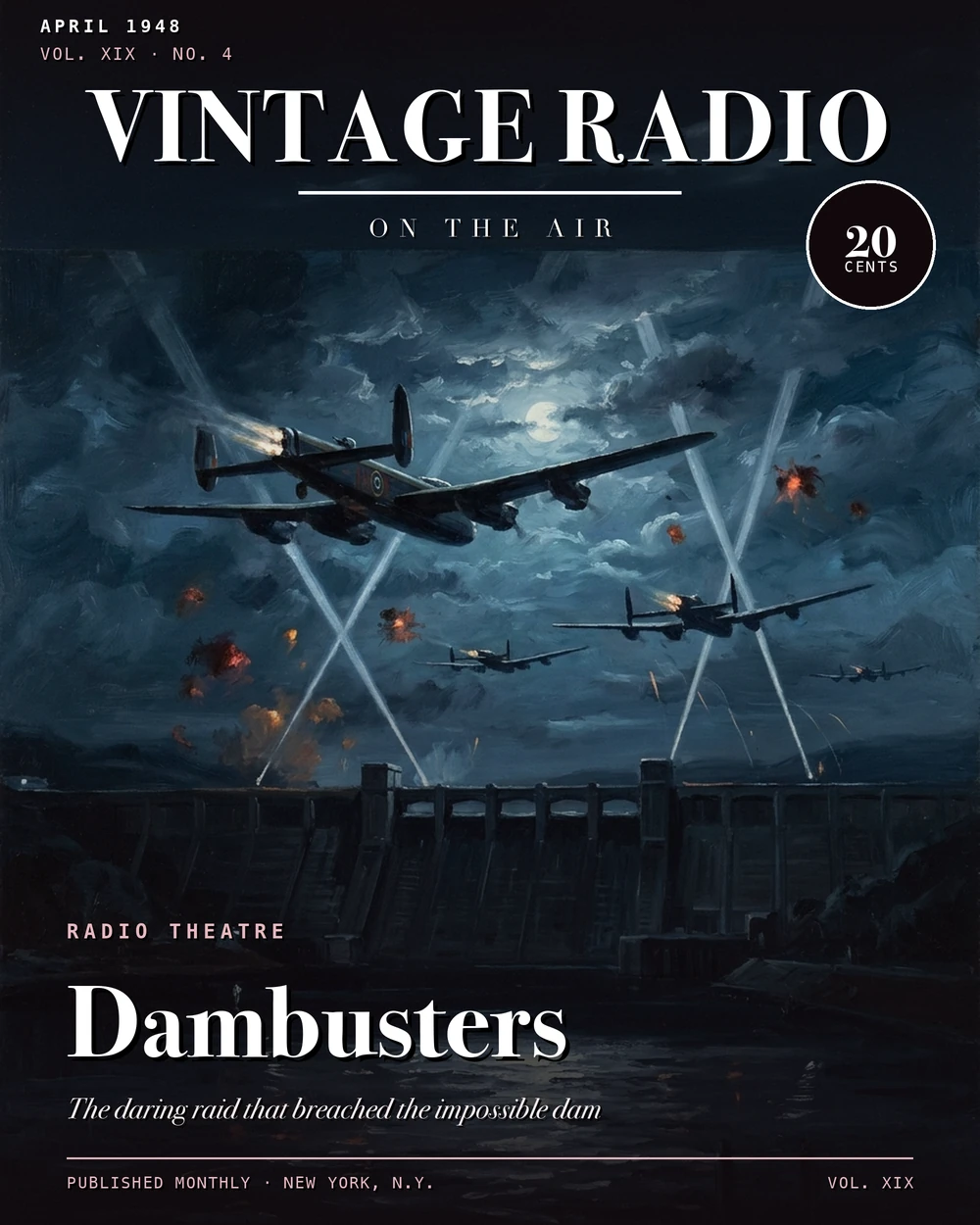
Dambusters
The Show Behind the Story
Few wartime operations have lodged as deeply in popular memory as the raid on the Ruhr Valley dams, and few radio series set out to cover that story with the depth and authenticity that the 1954 Australian production of Dambusters did. Produced by Australasian Radio as a dramatisation of Paul Brickhill's 1951 bestseller The Dam Busters, the series ran to 26 half-hour episodes — roughly eleven and a half hours of radio drama in total — and treated its subject with an ambition that went well beyond a simple retelling of one famous night in May 1943.
What set the series apart from the start was its scope. Only the first half-dozen or so episodes deal with Operation Chastise itself — the Royal Air Force raid on the Möhne, Eder, and Sorpe Dams on the night of May 16–17, 1943. The remaining twenty episodes follow 617 Squadron through the rest of its wartime career, tracing the unit's subsequent precision bombing campaigns as it became the RAF's specialist force for targets that required something beyond ordinary accuracy. That longer view gives the series a weight that a straightforward account of a single famous raid could never have achieved.
The Courier-Mail in Brisbane called it "the most authentic radio dramatisation ever presented" when it aired in September 1954 — a judgment that speaks to what the production team had managed to put together.
The People Who Made It
The series was scripted by Morris West, who in 1954 was still years away from the international fame he would earn as a novelist — The Shoes of the Fisherman and The Devil's Advocate were still ahead of him. His scripts provided the foundation, but the production's authenticity came from the people in the studio as much as from the page.
Producer Gordon Grimsdale was himself a former fighter pilot, which meant the two people most responsible for shaping the series had a combined feel for how wartime airmen actually spoke, thought, and behaved.
Paul Brickhill, the Australian author whose book the series adapted, served as narrator, introducing each episode in his own voice. Brickhill had flown with No. 92 Squadron RAF while attached from the Royal Australian Air Force during the war, so he was not a detached observer but someone with direct experience of the world the scripts portrayed. His book had been published by Evans Brothers in London in 1951 and was already a bestseller by the time the radio adaptation went into production.
Grimsdale made a deliberate effort to staff the cast with former servicemen. The result was a production in which the actors playing RAF airmen had, in several cases, actually been RAF or RAAF airmen.
The Cast
Charles "Bud" Tingwell played Wing Commander Guy Gibson, who led the dams raid and was awarded the Victoria Cross for doing so. Tingwell had flown Spitfires and Mosquitoes in the Western Desert during the war as an RAAF pilot — experience that gave him something real to draw on when voicing a character he had, in a sense, something in common with.
Rod Taylor, who would later become internationally known for his roles in The Time Machine (1960) and The Birds (1963), played pilot David Shannon. The Golden Age of Australian Radio Drama later described Dambusters as "probably the finest work Rod [Taylor] did in Sydney radio."
The rest of the principal cast carried a similar weight of service experience and craft. David Eady — credited as "David Eadie" in some sources — played Air Vice-Marshal Cochrane and had been awarded the Distinguished Flying Cross during the war, having taken part in the first raid on the Tirpitz. Ex-RAAF flight-lieutenant Max Osbiston played Australian ace Mick Martin. James Mills voiced Barnes Wallis, the engineer whose invention made the raid possible. Other parts were taken by Alan Trevor as Leonard Cheshire VC, Maurie Powell as Arthur "Bomber" Harris, Barry Cookson as Willie Tait, Coralie Neville as Ann Shannon, David Butler as Ralph Cochrane, and Harp Maguire as Joe McCarthy, alongside a larger ensemble that included Gordon Chater, John Ewart, Alexander Archdale, and others.
The density of actual service experience in the cast was unusual even by the standards of 1950s Australian radio drama, and it shows in what the press made of the result.
Operation Chastise and 617 Squadron
The heart of the series — even if only a fraction of the full run — is the story of what Operation Chastise actually was and how it came to happen. 617 Squadron was formed on 21 March 1943 at RAF Scampton under Wing Commander Gibson specifically to carry out the attack on the Ruhr dams. Its personnel were drawn from the Royal Canadian Air Force, the RAAF, and the Royal New Zealand Air Force as well as the RAF itself.
Barnes Wallis, assistant chief designer at Vickers Armstrong, had developed the weapon that made the plan viable: a 9,000-pound cylindrical mine, codenamed "Upkeep," designed to be dropped at low altitude and spun backward so that it would skip across the surface of the reservoir, clear any torpedo nets, sink against the face of the dam wall, and detonate at depth via a hydrostatic fuse. The crews flew specially modified Avro Lancaster bombers and had to approach their targets at precise altitude and speed — conditions that made the mission extraordinarily dangerous.
On the night of May 16–17, 1943, 19 aircraft carrying 133 aircrew set out. Eight of the 19 did not return. Fifty-three men were killed and three more were taken prisoner. The Möhne and Eder Dams were breached; the Sorpe was not. The flooding that followed caused significant disruption to German industrial production in the Ruhr, and the mission reportedly had a severe psychological effect on German morale. German industry proved resilient — an estimated 30,000 workers were commandeered to repair the damage and production resumed within months — but Operation Chastise nonetheless diverted anti-aircraft batteries and other resources away from the Eastern Front. Gibson received the Victoria Cross; 32 other aircrew received honours.
617 Squadron's motto, approved by King George VI, was "Après moi le déluge" — After me, the flood. The squadron badge shows a dam bursting. The motto was not chosen frivolously.
A Particular Moment in Australian Radio
The series was produced during what has been described as the golden age of Australian radio drama — a period when government import limits on foreign programming pushed Australian broadcasters to invest in local production. That policy context created an environment in which ambitious, large-cast drama series could be funded and made. Without it, a 26-episode dramatisation of a wartime history book, staffed largely with former servicemen and narrated by the book's own author, might not have been economically possible.
Grimsdale and West went on to adapt two more Brickhill books for Australian radio: The Great Escape and Reach for the Sky, the latter of which also starred Rod Taylor, this time as Douglas Bader. The three adaptations together represent a sustained effort to bring Brickhill's wartime narratives to radio audiences in a form that matched their source material's seriousness.
The 1955 film The Dam Busters, starring Michael Redgrave as Barnes Wallis and Richard Todd as Guy Gibson, was drawn from the same Brickhill book and became a well-known cultural touchstone in its own right. The radio series, made and broadcast the year before the film's release, drew on the same source with the same ambition — and with the added weight of a cast that had, in several cases, lived some version of the story they were telling.